Thursday, September 19, 2013

San Francisco in 2 Nights - Western Addition, Richmond, Presidio & Nob Hill

It's time to write about this year's trip back to the Mother Ship. For those of you just joining us here at Our Tripping Mystery, we (my two teenagers and I) write about (some) of our travels; although, lately it feels like we never go anywhere because we're too stinkin' busy with all of their activities. However, we do make a yearly trip back to San Francisco, and we were finding that no one had ever heard of the places we were visiting. "Did you go to Pier 39?" "How about Fisherman's Wharf?" "Union Square?" Umm... no, no, and no. So for the San Francisco stories, we usually feature a particular neighborhood or two, and learn about some local history. For this piece, Patrick will be writing about the Presidio, Rebecca will be writing about the Haas-Lilienthal house and Nob Hill, and I will pick up the surrounding jaunts.

Part of what has been holding me up from getting this post done starts with the first problem of what to even title it. NEVER in my time living in San Francisco did I refer to this geographic area as the "Western Addition," but I have settled upon this title as my starting point for the basic reason that in 0.63 of a mile I cover what I would call: Japantown, Lower Pacific Heights, and the Fillmore. Here's the first section of the walk . . . The part that takes you to breakfast and the bus stop:  http://www.mapmywalk.com/routes/view/284208747

We've stayed at Hotel Kabuki before because it is so easy to PARK if you're on a road trip. Plus, you're in the center of the city and close to the 38 Geary bus which can take you anywhere with a transfer or two. I park my car and forget about it while I'm there. It's part of the San Francisco experience. I easily drive 50+ miles per day at home because I have no other option so I'm happy to let public transportation cart me around a city that is less than 50 square miles altogether. I have a MUNI app on my phone, and I've never felt that there was anywhere that I couldn't get via public transportation in San Francisco.

Hotel Kabuki also feels exotic to me; like I'm really on vacation. Just hang out by the Peace Pagoda in the center of Japantown, and you will feel like you're in a foreign country. It makes a great meeting place and start for my day's walk.


Starting out walking west along Sutter Street, you will come to the Bush Street-Cottage Row Historic
District on the right side of the street. There's a cute, little park in here, and a series of Victorian houses built between 1870 and 1885. Rebecca will go more into the Victorian influence in San Francisco (shortly), but these houses are classic examples of the Italianate and Stick-Style that are so prevalent in San Francisco. The Japanese originally came to San Francisco in the 1860's after the California Gold Rush of 1849 gave San Francisco its boom. At first, the Japanese settled in Chinatown, but after the 1906 earthquake and fire, they migrated west of Van Ness Avenue to this area called the Western Addition where they lived in these homes with fabulous vegetable gardens. At one point, this area called Japantown had one of  the highest concentrations of Japanese outside of Japan. Unfortunately, during World War II, the Japanese were forced into internment camps and vacated the area, many never returning. During the Second Great Migration, roughly World War II to the 1970's, African Americans left the South and settled into many areas of the West including this area of the Western Addition along the Fillmore street corridor south down to Haight Street. The area again went through a renaissance with jazz, blues, and the famous Fillmore Auditorium. I always thought Yoshi's Jazz Club was an interesting summary of this area: a club playing African-American-rooted music, serving Japanese food, and started by a World War II orphan. The newly remodeled Hamilton Pool & Rec Center has a beautiful new mural completed in 2010 by Santie Huckaby and the Blues and R&B Music Foundation, Inc. called "The Blues Evolution." I love this mural, and I'm so happy to see that it made it onto the Lower Pacific Heights side of the Western Addition at Post & Steiner Streets right across the street from the Jones Memorial United Methodist Church in honor of the first Black Bishop of the Methodist Episcopal Church. Here you feel like you are truly in the Fillmore.

"The Blues Evolution" on Hamilton Pool
But back to breakfast which is where we were headed! Less than a block away from this mural and the entry point to the Fillmore District, on the corner of Sutter and Steiner Streets, is Sweet Maple with the famous "Millionaire's Bacon." Here's how you know that Lower Pacific Heights is migrating southward . . . even the bacon is getting pricey around here! I'm not sure what they do to their bacon. There was some sort of information on the wall . . . oven roasted, dipped in maple syrup and chiles or something, but it is DELICIOUS. Go here and fuel up for lots of Presidio hiking trails later on.

Millionaire's Bacon at Sweet Maple
Moving out of these various cultures that make up the Western Addition, you can catch the 38 bus on Geary Street and get off in the Richmond District at the corner of Geary and Arguello. Here is a little map of this segment of the trip: http://www.mapmywalk.com/routes/view/267324387. After getting off the bus, turn left on Arguello, and walk south down the street until Anza and turn left again, walking east along Anza. Once again, it's really hard to say if you are on the far eastern border of the "Inner Richmond" here, or if this location right across from Rossi Playground, is actually the southern border of Laurel Heights or the northern border of the Lone Mountain area. For sure, you can see the hills of the Jesuit's University of San Francisco from here. Just two blocks up Anza, you will turn left on a small dead-end street that is Lorraine Court. At the end of the street is one of San Francisco's little-known jewels: the San Francisco Columbarium.

Columbarium
This building was constructed in 1898 when this area was predominantly cemeteries before a city ordinance forced them all to move south of the city. Just a little history . . . the area that is the Richmond District was full of sand dunes and referred to as "Outside Lands" because it was originally "outside" the city boundaries during the Gold Rush boom of San Francisco in 1848. (How the "Outside Lands Festival" in Golden Gate Park got its name.) The area officially became part of the city of San Francisco in 1866, and Golden Gate park was commissioned in 1871. Bernard J.S. Cahill was inspired to build the Columbarium in the neo-classical style after attending the Chicago World's Fair (Columbian Exposition) of 1893. The stained glass windows and rotunda are gorgeous, and if you visit, be sure to hunt down all the famous people including Harvey Milk.


Thought Mike might like these folks for neighbors . . .


I was pretty inspired by this idea for an urn . . .


From the Columbarium, walk back to Arguello and head north through the Inner Richmond. Clement Street to the left (west) of Arguello makes a nice stopping stop for lunch and has some great little shops like Green Apple Books and restaurants such as Burma Superstar. They also have the weekly Clement St. Farmers Market on Sundays. I like the vibe here on Clement Street . . . it's like a "real" Chinatown and feels neighborly. Parts of the Richmond District were used in Woody Allen's recent movie "Blue Jasmine," but unfortunately it still felt like New Yorkers in San Francisco to me. I like Woody Allen movies, but I'm not sure he hit San Francisco's "feel" with this movie. Spend some time on Clement Street, and you'll get what I mean. After wandering up and down this street, head back to Arguello, and back up the hill to the Arguello Gate of the Presidio.

The Presidio
By Patrick
We have a long tradition of hiking in the most absurd places on our trips. This time we decided to hike in a former military base called the San Francisco Presidio. Here is some basic history of the Presidio.


The area where the Presidio now stands was once the home of the Ohlone and Costanoan people. Around 1776, the Spanish empire started Mission Delores and established the Presidio as its northernmost military base to defend the western side of America from European settlers. It remained under Spanish command until 1821 after the Mexican Revolution and the Presidio transferred it’s allegiance to Mexico. During this time, Mexico also opened all of its ports to trade and divided the surrounding land around the Presidio (at that time belonging to the indigenous people) to former soldiers which many used for farming, which forced many now homeless natives to work as field workers. The Presidio under both Spanish and Mexican rule was never well supplied. Due to this fact, the Mexican People living in the Presidio forced more natives to work the fields in order to support the Presidio. This caused a greater spread of Spanish diseases amongst the natives and also forced the settlers at the Presidio to abandon it. After the outbreak of the Mexican-American War the then vacant Presidio was occupied by the U.S. military in 1846 which it remained under until 1994. Around 1874, the Presidio underwent major developments including roads, re-forestation, and the transition to an “open post” styled base, which allowed civilian’s limited access to certain areas of the base. After 1994 the Presidio was transferred to the National Park Service which it remains apart of today. Between those last two dates was when the Presidio also began developing itself as a National Park. 

The Presidio gained 11 trails during this period and also a free public bus system for within the park called the PresidiGo. It was along two of these trails that we went hiking. They were the Ecology Trail and the Inspiration Point trail. Shortly after entering the Presidio though, we found what appeared to be a massive tree shaped tower made of dead trees. Upon further research, the structure was actually a public art sculpture called the Spire. This piece was made in 2008 by the artist Andy Goldsworthy out of Cypress trees that had been cut to allow healthier trees to grow in their place. After stopping to admire this artwork, we started taking the Ecology Trail further into the Presidio. This trail has very scenic views of the San Francisco bay and also includes information about the wildlife that lives there. After making a quick stop to see Inspiration Point, we followed the rest of the trail through to the Officer’s Lounge where there is now a hotel where you can stay within walking distance of these trails. Once we were ready to leave, we took one of the PresidiGo shuttles that route all around the park to Baker Beach. From here, you can get on a Muni Bus that goes back to the 38 Geary bus. 


The Spire by Andy Goldsworthy


View from the FREE PresidiGo Shuttle

Victorian San Francisco
by Rebecca

For my portion of this blog post, I will tell you a little about the Victorian Era in San Francisco and why it's such a prominent feature of the city. I chose to do my piece on this part of San Francisco because I'm helping with the dramaturgy for my theater groups production of Shakespeare's "As You Like It" in a Victorian steampunk setting, so most of my research is already done.

One of the main reasons why Victorian architecture is so prominent in San Francisco is because the city got a boom in its population during the Gold Rush of 1849. Thousands of people were passing through the city and because of this sudden population growth, most of  the houses were made during the same time period. As the years of the gold rush continued, certain people started getting richer and the houses started getting more elaborate and we got the grandiose homes on Nob Hill and, just slightly of lower class, homes like the Haas-Lilienthal house.
Haas-Lilienthal House
We started our day with a trip to the Haas-Lilienthal house, which is a great example of the Queen Anne style of Victorian architecture. It is a very elegant house that shows how, even in America, this was a time of great prosperity, especially in San Francisco. One of the most noticeable differences between Georgian and Victorian houses is how, in the Victorian Era, the columns on the houses started getting smaller and fewer. There was also an increase in the use of bay windows and porticos. Inside the Haas-Lilienthal house, we saw many, many pocket doors, a half gas, half electric chandelier, and what is called a jib door, which was used to avoid the tax on doors by combining an upward-sliding door into a window.

Electrolier, Haas-Lilienthal House
After our trip to the Haas-Lilienthal house, we went on a walking tour of Nob Hill where these Victorians become more like castles rather than houses. The tour started at the Stanford Court Hotel, which used to be the home of Leland Stanford; a California politician and a member of the "Big Four," the name given to the primary creators of the Central Pacific Railroad (CPR). These four men, Leland Stanford, CPR President, Collis Potter Huntington, CPR Vice President, Mark Hopkins, CPR Treasurer, and Charles Crocker, Construction Supervisor, took advantage of the gold moving across the country from California and ended up making a fortune. Across the street from where Collis P. Huntington's mansion had burned down and was turned into Huntington Park, stands the Huntington Hotel, named in his honor. Next to the hotel is the Crocker Garage, named after Charles Crocker. He had planned on having a hotel built as well, but never had enough money to do so, so all he was able to build was a garage. His mansion that was next to Huntington's mansion also burned down in the earthquake and fire of 1906. At the corner, across Mason St. from the Crocker Garage, and across California St. from the Fairmont Hotel is the Mark Hopkins Hotel, built on the original site of his mansion that also burned down in the fire. 

Looking out from the Mark Hopkins Hotel
Fairmont Hotel
Venetian Room, Fairmont Hotel
As you can see, the San Francisco earthquake and fire of 1906 took a toll on the Victorian houses, which makes the surviving houses all the more unique. Here in Arizona, we don't have many Victorian houses because there were hardly any people of European influence in the area. And for the ones who were, not many had enough money to build such elegant houses as are a frequent theme upon Victorian style architecture. This is why they are fascinating to me, but they are also fascinating because it's incredible to find so much Victorian influence in one place. These beautiful Victorian houses are a major part of San Francisco's history; the beginning. 


** The only other parts I wanted to add, in addition to Patrick and Rebecca's pieces are: Grace Cathedral & the AIDS Chapel with its Keith Haring altar, dinner at Mums Home of Shabu Shabu for hot pot dinner in Japantown, and Andersen Bakery for quick grab and go breakfast on the morning of departure. A side trip after Baker Beach could also be California Palace of the Legion of Honor


Part of the AIDS Memorial Quilt in Grace Cathedral
Keith Haring altar in Grace Cathedral's AIDS Chapel
Mums Home of Shabu Shabu
Andersen Bakery case

Sunday, September 9, 2012

San Francisco in 2 Nights - Mission District, Bernal Heights & City Hall

"Artists not only document social change; they promote, inform, and shape it. Whether through music, plays, graphics, paintings, songs, films, media, architecture, textiles, jewelry, photography, poetry, sculpture, pottery, landscapes, written word, dance - art is powerful ... For art is the intellectual underpinning of social change; nowhere is there more potential and more need for art than now." ~ Maria X. Martinez  from "The Art of Social Justice"

"Indigenous Eyes" by Susan Kelk Cervantes
When I think of some of the things that I truly miss about living in San Francisco, I often come back to the sense of community found in the various neighborhoods of this densely packed 47 square mile city. Each district in the city has its own personality and its own reputation. I wrote last year about the Tenderloin in "San Francisco in 2 Nights - Tenderloin, Financial District, Russian Hill & Telegraph Hill," and this year, I was lucky enough to spend two nights in the Mission District. In the early 1990's, I didn't spend a lot of time visiting this neighborhood. My trips were limited to pretty specific endeavors. One was thrift store shopping -- that was easy -- get off at the 16th & Mission BART station and proceed to Thrift Town. The other was in search of  a swankier laundromat. In our early years together, "Where should we do our laundry tonight?" was akin to, "Where do you want to go out tonight?" We've had some memorable laundromat dates. There was the night that we won the raffle at the Clean-X-Press in the Tenderloin, and we got a Clean-X-Press clock. Sadly, that location is gone now, but we still have the clock. Another night, we were at a laundromat glued to the TV while O.J. drove his white SUV around the Los Angeles freeways -- I thought we would never get home, but we still remember it like, "Where were you when JFK was shot?" One of our favorite laundromat dates was doing the laundry on Taraval Street and getting dinner at El Burrito Express. There is nothing like a San Francisco El Expresso (wet) style burrito on a foggy San Francisco laundry night. This became a ritual for us, and I feel that it was a contributing factor as to why we never felt the need to venture into the Mission District for Mexican food. The exception to this rule occurred after I took a San Francisco history class at SFSU and learned that San Francisco was key in the popularity of the tamale, and there was one lone tamale restaurant, Roosevelt Tamale Parlor, left in the Mission District (it is still there -- been there since 1919!) Yes, the first "tamaleros" were sent from San Francisco to the Chicago World's Fair (Columbian Exposition of 1893.) After that success, a tamale cottage was opened up at the Midwinter Exposition in San Francisco in 1894. I'm going to plug my professor's book, The Fantastic Fair, (which doesn't seem to be in print anymore), along with the only recent article I can find about San Francisco's tamale history (but it's an awesome article): "When We Were Red Hot: S.F.'s Tamale Industry Once Ruled America" by Gustavo Arellano. So another laundromat date included dinner at Roosevelt Tamale Parlor with their big, round tamales smothered in dark red chili sauce, and then topped off with a trip across the street to Panaderia La Mexicana for dessert where you grab tongs and a tray and select cute little Mexican pastries out of the bakery case and wash them down with cinnamon-infused Mexican coffee. Yes, this place is still here -- hooray!


So as I began planning our trip, I was discouraged to find that much of what I thought I knew about the Mission District was blanketed by all of the Yelp descriptions of Mission "hipster" joints -- a term that I just recently discovered does not mean a type of women's underwear. Yes, there is a new cash flow that has come into this neighborhood; however, the unique culture has been largely preserved by its public artists. San Francisco has over 800 public murals -- many of these are quite famous: such as, the murals in Coit Tower and those by Diego Rivera at the Art Institute, City College, and the City Club. But out of these 800 murals, 328 of them are currently located in the Mission District. I love that so much of the history of this neighborhood is chronicled right out in public for all to experience: from the Ohlones to the Franciscans that founded Mission Dolores (San Francisco's oldest building) to the dairy farmers to the German and Irish immigrants post-Gold Rush to earthquake cottages at Dolores Park to Latin American immigrants -- art tells the story of these social changes everywhere in the Mission District. Murals to me are amazing. For all that think that art and the study of art history is a bourgeois pursuit, look at murals out in the open for all to see! We forget that some of our most famous works of art are largely considered murals; for example, Michelango's Sistine Chapel ceiling and the Creation of Adam could be considered a mural, as well as the ancient Roman wall art found in Pompeii as far back as 200 BC. It's true, however, that most people view modern murals as political statements. When I told friends that I was going to learn about murals during my San Francisco weekend, I think the image that conjures is more evident of the Berlin Wall or Keith Haring or graffiti. I think murals are all of that and more and a great way to rejuvenate a neighborhood. I think I'll go ahead and share some photos of what I experienced during my weekend with a brief trip log and links on how it can be organized over a 3-day weekend. For me, blogging about my trip is just a way for me to collect my thoughts all in one place, set the example for my homeschooled kids to write stuff, and perhaps expose my readers to another way of seeing a touristy destination.

Saturday at 1:30PM - Precita Eyes Classic Mission Mural Tour (24th & Alabama)
Precita Eyes Muralists working in Balmy Alley located between 24th & 25th Streets and between Treat & Harrison

"Naya Bihana" by Martin Travers in Balmy Alley depicting the struggle for freedom in Nepal

 
"Things Fall Apart" by Janet Braun-Reinitz in Balmy Alley with a quote from the poem "The Secong Coming" by W.B. Yeats
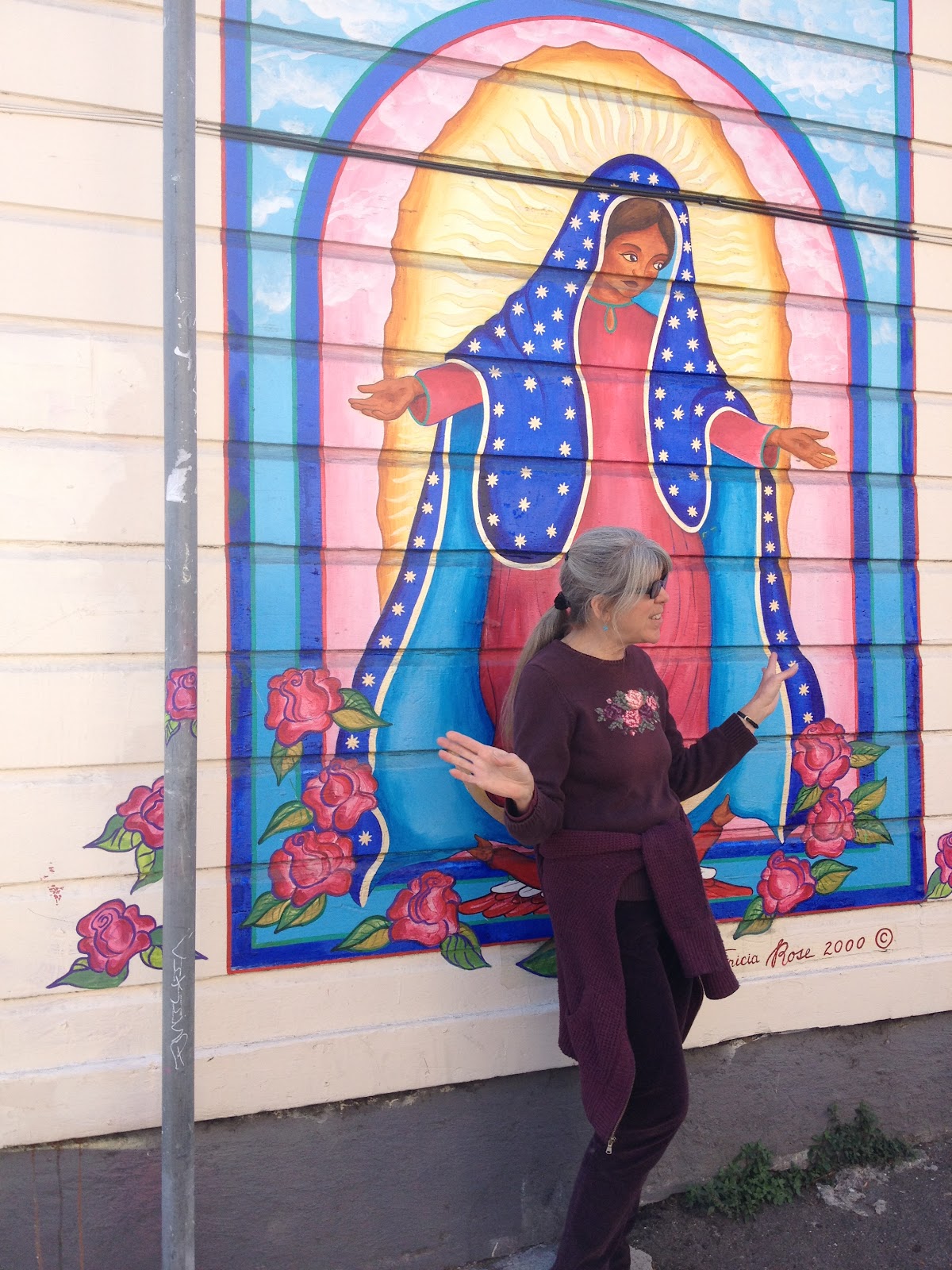
"La Virgencita"by Patricia Rose who is also the artist standing in front of the mural. She doubled as our Precita Eyes tour guide. I don't think she was trying to look like the Virgin in the mural in this photo, but she was explaining to us that it was okay to paint on the street pole because it is a private alley. I love that she is also wearing roses on her sweater :-) She is wonderful!
Utility box depicting actual neighborhood residents.

"500 Years of Resistance" by Isaias Mata on St. Peter's Church

24th & York Playground & Splash-pad (right next to Panaderia La Mexicana for an afternoon snack)

Tile murals at the Mini-park

"Quetzalcoatl" mosaic play structure (his tail makes the splash area)
Plantains for sale at the market

Neighborhood flower vendor

Saturday at 4:30PM - Hiking Bernal Heights Hill (from Folsom & Bernal Heights Blvd.)

The view from the top with the Bay Bridge and Treasure Island in the top right

Saturday & Sunday nights - The Inn of San Francisco (Van Ness & 20th Street)

The parlor of this gorgeous home

Saturday night dinner - La Traviata (Mission & 24th Street)

Sunday at 11:00AM - San Francisco City Guides Mission Dolores Neighborhood Walk (Church & 20th St.)
The fire hydrant that saved the Victorian homes of the Mission District from the 1906 earthquake and fire
Dolores Park
New Mission Playground Water Play Area

Soon to be re-opened Mission Pool with "New World Tree" mural by Susan Kelk Cervantes 
Lone earthquake cottage 
The Pirate Store at 826 Valencia - a great organization that assists kids with writing skills. Watch the TED talk:  


Very cool metalwork tree across from the plaque signifying the first site of Mission Dolores at  Camp & Albion Streets
Mission San Francisco de Asis (Mission Dolores)

Sunday at 1:00PM - a walk through Clarion Alley (between Mission & Valencia and 17th & 18th Streets)
The grittier murals on Clarion Alley


Sunday at 2:00PM - Brunch at Foreign Cinema (Mission & 21st Street)

Sunday night we went to an amazing wedding, but if you want to follow in our footsteps and don't have the invitation, I would recommend an evening in the garden and the hot tub of the Inn of San Francisco :) My son has written a post about visiting San Francisco City Hall which could be done the following Monday of a long weekend trip. My daughter has written a creative writing piece as an assignment for her writing group that involves a muralist lost in San Francisco City Hall which was inspired by her visits to both places. They both are excited to publish their pieces so I'm including them here in one family blog post. Enjoy!

San Francisco City Hall Review 
by Patrick
Over Labor Day weekend, we went to San Francisco and learned quite a lot about the city and its buildings. We started at the City Hall building in the city’s Civic Center. We learned that the City Hall was built in 1915 to replace the old City Hall which was destroyed in an earthquake in 1906. It was renovated after the 1989 earthquake and reopened in 1999. The building is 307.5 feet tall at the dome making it the tallest dome in the United States and the fifth tallest dome in the world. The city hall building was designed primarily by Arthur Brown and John Bakewell. The two architects designed the dome with a French baroque style similar to les Invalides in Paris. They built the rest of the building with a Beaux Arts style, which is a blend of French, Roman, and Greek architecture. The City Hall building is very interesting, and I would definitely recommend visiting it. While we were there, we saw the mayor’s office and a bust of Mayor George Moscone who was assassinated in his office along with Supervisor Harvey Milk in 1978. After exploring City Hall for a little longer and running into about twelve people in Lederhosen outside of the County Clerk’s office (possibly there for someone getting married), we left City Hall and crossed the Civic Center park to the San Francisco Public Library to see its recent remodel.


Trapped 
by Rebecca
            The dense fog hung around me as I walked. Coils of it wrapped around my ankles and made me slow down. I could barely see twenty feet in front of me, but I knew where I was going. Everyone knew how to get to San Francisco City Hall.
            Earlier that day, as I watched the daily fog spill over Twin Peaks, I thought about how it would make a marvelous subject for one of my paintings. I would need some more gray paint though, and whenever I bought a gallon of new paint, it felt like I was paying with a couple years off my life. Was it really such a crime to be an artist that I have to starve myself? I was eating something, of course, but, surprisingly, a can of Spaghetti-Os every day isn’t a sufficient diet.
            I felt trapped in my life, stuck in a downward spiral towards bankruptcy, unable to escape because, let’s be honest, no sane employer would hire a person with minimal education and no job experience, who has spent their life as an amateur painter. Well, at least not a sane employer from a place where I could actually make a living. The only reason I have those Spaghetti-Os is from the small paycheck I get from working at Burger King.
            I really don’t make much money from my art; only on very rare occasions will someone want to buy one of my canvases. I mostly try to get the city to pay for me to paint a mural on one of their public buildings. I’m good at painting murals, I’m very tall, and I like to add miniscule details to things. It’s easier to do that when you have a larger “canvas.”
             As I turned a corner, I could just see the grandeur of City Hall through the obscuring fog. The shape was quite similar to the Capitol Building in Washington D.C., but San Francisco’s City Hall is taller and has more gold on it.
            I came up to the front steps and began to walk up them, holding the notebook that had my sketch of the hopefully future mural inside it, close to my chest. I came through the doors and passed through the metal detector without trouble. I kept walking straight until I came to the rotunda. It was a large hexagonal room with golden street lamps at every corner, beautiful carvings into the walls, and a marble centerpiece, the staircase. I stopped for a second to look around. Above my head, one could see the walls arching in to meet the dome, the inside of which was fully visible from the rotunda, with the four medallions, Equality, Liberty, Strength, and Learning, each on their own corner of the room. Across from the staircase, a depiction of Father Time was placed on the wall above a clock that surprised me as I read the time. Only ten minutes until the Hall closes!
            With the sudden need for speed, I climbed up the staircase, turned a corner and climbed the stairs that I saw in front of me up to the fourth floor. When I got to the top, I realized that I was a mess, and there was no way that anyone from the city planning department would seriously negotiate with me about getting a wall to paint if I looked like this. I located a bathroom and went inside to wash up at the sink. I soaked a paper towel, then dabbed it at my face and on my neck, brushed my hair, and straightened my clothes. I probably wasn’t going to be able to actually get a permit today, but maybe I could at least schedule an appointment.
            I had just come out of the bathroom, when every light in the building turned off. I stood there for a moment with complete darkness surrounding me. I let my eyes get adjusted to the light before I walked in the direction of the planning department office, holding my arms out awkwardly in case something was in my way.
            I knew how to get to the office, but I wasn’t sure if I could make it there in darkness without falling over the banister that looked down to the very first floor. So I tried to keep to the wall because the other option would most likely turn out very, very bad.
            I stopped at a big wooden door and put my face right in front of the plaque on the wall next to it. In the poor lighting, I could just read “City Planning Department.”
            I considered ripping out one of the pages in my notebook and leaving a note, but it was likely that no one would see my note if I slipped it under the door, and I didn’t have any tape with me for attaching it to the door or wall. I actually don’t have any tape in general. Also, even if I did have tape, then what? I knew from previous news stories that when the Hall closed, they locked both the inside and outside. So if you were stuck in the Hall at night (like I am) and were planning on stealing some valuables (like I am not), you wouldn’t be able to take the out of the building because you were locked inside. Basically, I was stuck in City Hall.
            So, with no better option, I took off my jacket and balled it up. I then lied down on the floor, with my jacket under my head, curled up, and fell asleep on the floor in front of the City Planning Office.
            The next morning, I was nearly skipping down the street in excitement to get home to gather up my supplies. After looking at my sketch, the city planners decided to permit me to paint on the wall of a park. Not only that, but they agreed to pay for the paint and pay me for painting the wall. They were letting me be free of my current predicament, both metaphorically and physically. And they gave me a scone!